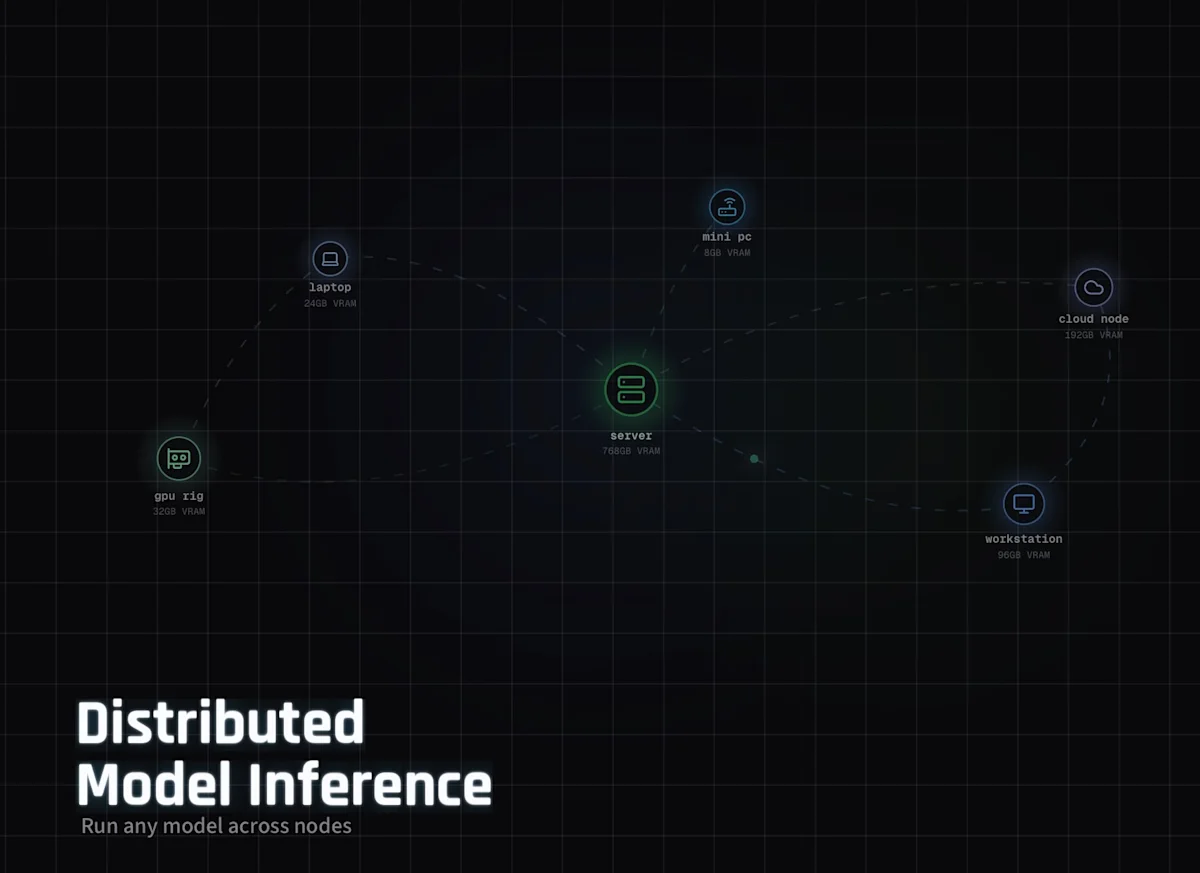

With the Buzz "share compute" feature, compute inside a community can be pooled to power inference.
This is powered by MeshLLM. We recently shifted day-to-day development onto Buzz — planning, reviewing, and shipping through Buzz. I (Mic) decided to do this one day to help keep track of all the threads and contributions. Our goal wasn't to revamp our development process. It was a lift and shift.
It went surprisingly well — no ceremony, no process redesign. It's easy to feel like that kind of change makes things faster. It's harder to show it.
What the setup looked like
MeshLLM has a few core contributors and dozens of semi-frequent ones — all volunteers. On Buzz we run one release channel, a few research channels, and short-lived topic or branch channels; conversations tend to roam. Channels ended up about half long-lived and half dynamic.
Work flows into the system mostly directly through Buzz, though sometimes via GitHub issues or an incoming PR. People bring their own agents — the ones they already use day to day — and those agents see the same channels the humans do.
So we did the boring thing: looking at matched workweeks — ten complete weekdays before the shift and ten after, with exactly two of each weekday on each side, weekends excluded — over the same repository and the same contributors, and measured what actually changed.
A few things stood out: PRs merged faster, more code got deleted, and more work landed overall. Qualitatively things seemed more stable too (though as a volunteer-run OSS project, we don't have MTTR-style stats to prove it).
More shipped
Raw throughput jumped: PRs opened more than doubled (59 → 128) and PRs merged rose 56% (62 → 97) across the matched weeks. The scope of work widened too — files touched in merged PRs more than doubled (~1,100 → ~2,400).
| Metric | Before | After | Change |
|---|---|---|---|
| PRs opened | 59 | 128 | more than doubled |
| PRs merged | 62 | 97 | +56% |
| Merged line churn | ~203k | ~337k | +66% |
| Files touched in merged PRs | ~1,100 | ~2,400 | more than doubled |
Delivery time improved
Measuring PR opened → merged across the matched weeks, median time to merge dropped from about 7 hours to about 4 — nearly halving. That's elapsed wall-clock time, including nights and weekends.
Reviews are both human and agent-assisted, and made easier by the Buzz chatter itself: the why and the decisions are usually already in the channel, so much of review is fairly mechanical. Large or bulk changes are agreed ahead of time — clearing the slate, so to speak — which removes one classic bottleneck before it forms.
| Metric | Before | After | Change |
|---|---|---|---|
| Median open → merge time | ~7 hours | ~4 hours | nearly halved |
| PRs opened per weekday | ~6 | ~13 | more than doubled |
| PRs merged per weekday | ~6 | ~10 | +56% |
More code deleted — a lot more
This one excited me the most. In the agent era it is easy to ship a terrifying amount of code quickly. Much excitement, reporting and even benchmarks are often focused on one or few shot tasks, well known activities or net new projects, less so on the day to day grind maintaining things for many platforms at the same time as adding new non trivial features.
Merged line churn rose 66% (~203k → ~337k lines) — and that's not all additions; deletions rose right alongside, with refactoring and dead-code removal carrying a real share of it. That's exactly the kind of tedious work that used to lose out to feature pressure.
This project is unashamedly agent-native, and even with the acceleration we saw what looks like an improvement in quality — if we take deletions, structural changes, and chores as part of that.
The main branch got busier
Files touched in merged PRs more than doubled across the matched weeks. Being busier isn't a virtue on its own — but what we saw was work getting done that we wouldn't have prioritized otherwise, like a large legacy Rust chunk that finally got retired. Full methodology, weekday-by-weekday breakdown, and a reproduction script are in this analysis.
What we take from it
Pretty happy overall, and have barely scratched the surface on ways of working. It is also worth noting this is a microcosm, small team, mostly volunteers, an open source project. Hopefully this could extend to larger teams too, and would be fascinating to see if it does.
It really seems to be a boost that people see others' work happening in real time — and their agents see it too. That's especially handy when people span timezones and continents and coordination is hard.
The takeaway: a big boost in throughput, and more tidying and quality work, without really changing how we work — helped by the fact that everyone could simply bring the agents they already use.